Reverse Engineering · Field Note 002
FN—002They Copied the Format. But Did They Copy What Made It Work?
Two illustrated finance channels covered some of the same stories. One reached millions. The other reached hundreds or thousands. I compared the ideas, packaging, and scripts to see what the visible numbers may be hiding.
What happens when you copy the visible parts of a successful format but the results still do not follow?
- Filed
- Research date
- Reading time
- 24 min study
- Subject
- The Financial Archives, compared with Crayon Capital
- Channel
- The Financial Archives
- Comparison channel
- Crayon Capital
- Problem
- Format / Content Product
- Category
- Finance / Documentary
- Tags
- Reverse Engineering · Format Strategy · Finance · Storytelling · Packaging · Documentary · Idea Strategy · Audience Expectation · Small Channels · Competitor Analysis
Public figures in this Field Note are historical observations from the original research, not current counts.
01 — What caught my attention
The Observation
01 · The puzzle
Two similar subjects. Two very different results.
The Financial Archives is a small illustrated finance channel. Crayon Capital is a much larger illustrated finance channel. At the time of research, Crayon had about 243,000 subscribers and 28 visible videos.
The channels sometimes cover remarkably similar stories. That gives us something useful: we can compare what two creators did with similar raw material.
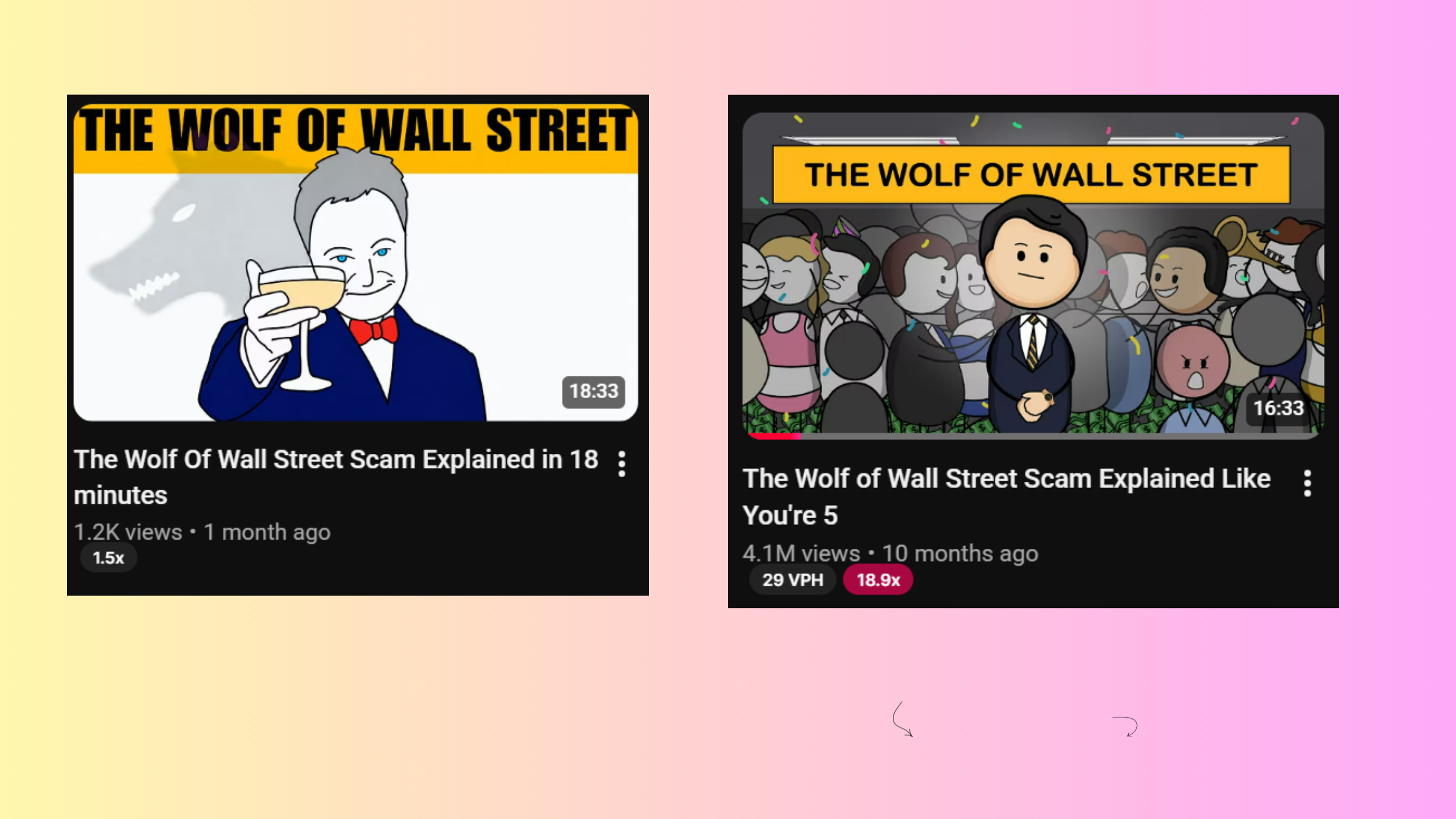
The Wolf of Wall Street
≈3,417× gap
- Crayon Capital
- ≈4.1M views
- The Financial Archives
- ≈1.2K views
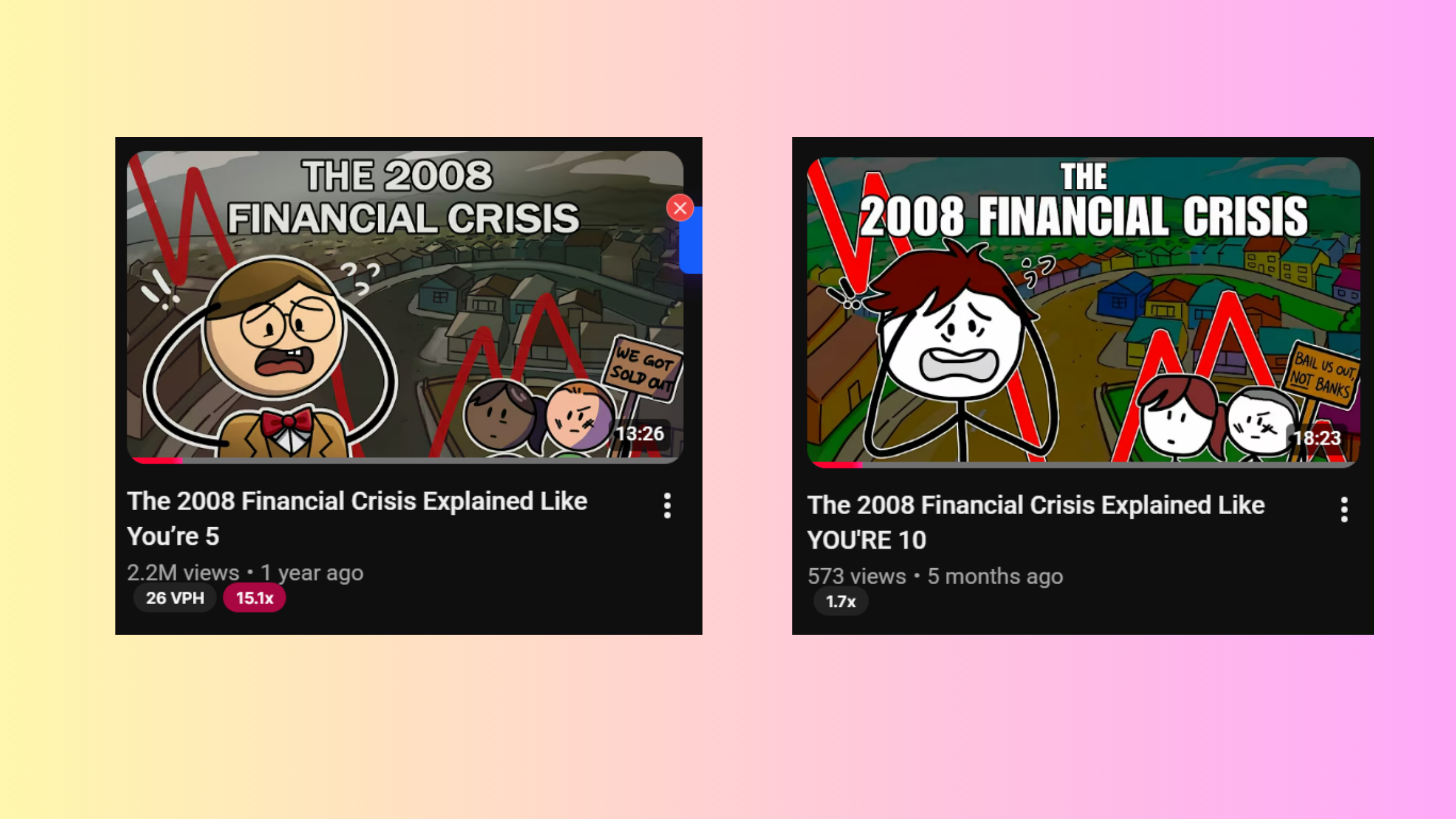
The 2008 Financial Crisis
≈3,860× gap
- Crayon Capital
- ≈2.2M views
- The Financial Archives
- ≈570 views
Approximate public counts recorded on 21 August 2026. These are labeled comparisons, not a controlled experiment or proof of cause.
How can two channels cover nearly the same story and end up with results this different?
02 · First, look at the channels
They have historically sold different promises.
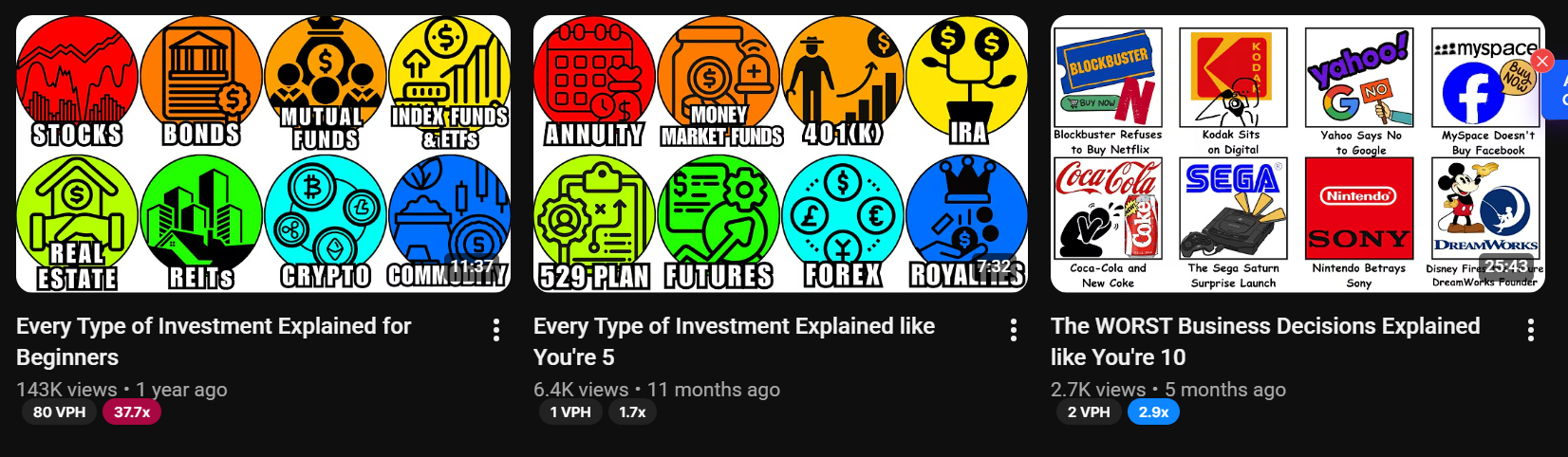
The Financial Archives historically published many broad educational videos: every financial term, every market crash, every investment type, every fund and every level of wealth. Its thumbnails often split the frame into several ideas, icons or categories.
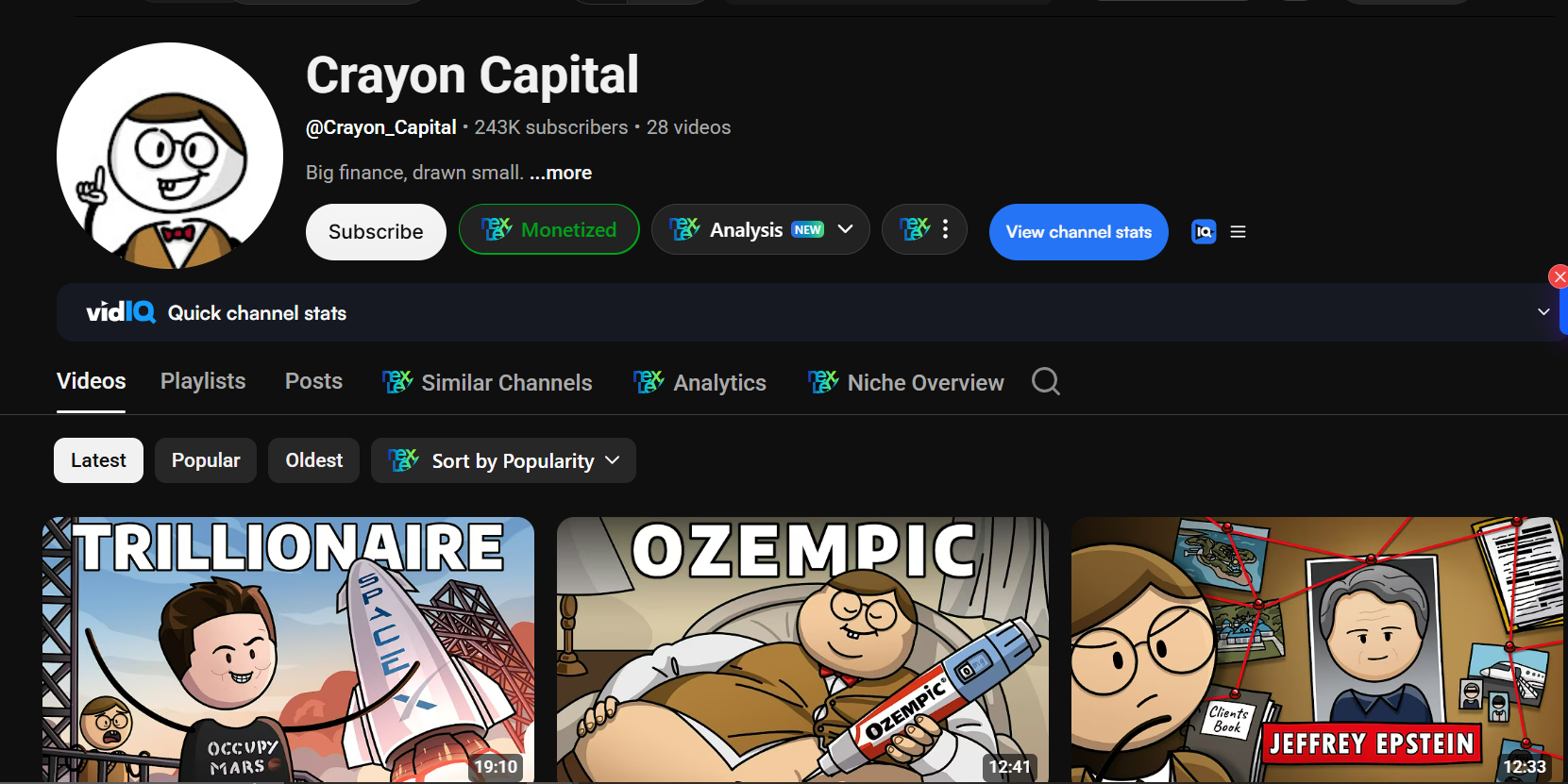
Crayon Capital more often centers one person, company, scandal, disaster or economic mystery: Elon Musk, NVIDIA, Rockefeller, Theranos, the Great Depression, the 2008 crisis and the Wolf of Wall Street.
A — Category education
- Learn this whole subject
- Several concepts in one video
- Grid-style visual promise
B — Story-led finance
- Let me tell you what happened
- One central story
- One person, event or mystery
Neither product is automatically bad. But they give viewers different reasons to click.
03 · Something changed
The newer catalogue is already experimenting.
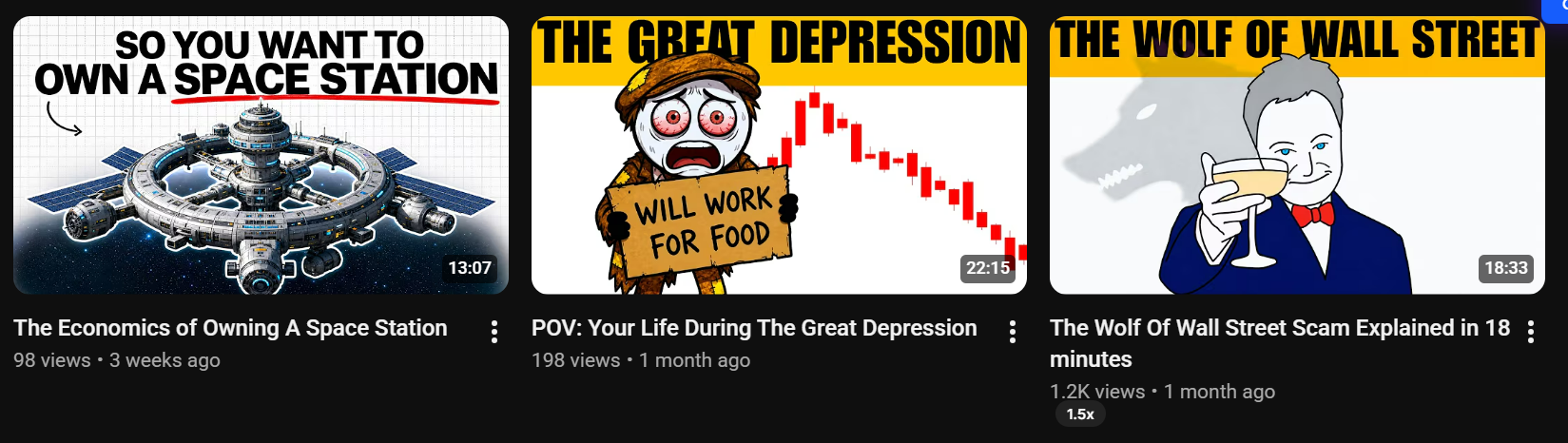
Newer uploads move toward individual stories, famous characters, historical events, POV concepts and more singular thumbnail subjects. The Wolf of Wall Street, life during the Great Depression and the world's first trillionaire are different products from a list of every investment type.
02 — The necessary context
What Happened
04 · Test the theory
Compare matched subjects, not random uploads.
The channels have different sizes, histories, audiences, upload timing and distribution. These matches are not a controlled experiment. But they let us inspect what each creator did with the same basic story.
05 · The 2008 crisis
Same event. Different opening.
The Financial Archives begins on 15 September 2008 with Lehman Brothers workers carrying boxes. It then goes back to the 1990s and builds the system: Glass-Steagall, bank types, deregulation and financial instruments.
That is traditional documentary structure. Start near the event, build the historical context, explain the machinery, then move toward the collapse. There is nothing inherently wrong with it.
Crayon starts with the catastrophe: an old bank collapsed, enormous value disappeared, jobs vanished and retirement accounts were hurt. Then it asks whether the real cause began with one simple promise about owning a home.
A — Financial Archives opening
- Begin near the historical event
- Go back for context
- Explain the system
- Build toward collapse
B — Crayon opening
- Show the catastrophe
- Create a mystery
- Ask what caused it
- Explain the machinery afterward
06 · Explain versus stage
One describes the system. The other often lets us watch it happen.
Financial Archives often explains what lenders, banks, rating agencies and investors did. Crayon frequently turns the same ideas into small scenes or exaggerated conversations.
A — Financial Archives
- Here is what happened
- Definitions give the animator information to illustrate
B — Crayon Capital
- Watch this happen
- Scenes give the animator concrete action to show
07 · Translate finance into pictures
The difference may be frequency and rhythm.
Crayon repeatedly turns finance into familiar pictures: a Jenga system, a paid-off food critic and absurd everyday versions of speculative insurance. Financial Archives also uses analogies, including a sausage factory for mortgage-backed securities and an insurance comparison for credit default swaps.
08 · Information rhythm
Both educate. The experience of receiving the information is different.
A — Financial Archives rhythm
- Learn
- Learn
- Context
- Learn
- Consequence
B — Crayon rhythm
- Question
- Explain
- Scene
- Surprise or joke
- Consequence
- New question
Crayon also uses small bridges that reopen curiosity: the story is not finished, Wall Street has another move, someone notices the problem, or something impossible happens. Each bridge gives the viewer another reason to stay for the next section.
03 — Receipts, numbers, artifacts
The Evidence
09 · New evidence
The Wolf script breaks the easy diagnosis.
After the 2008 comparison, it would be easy to say Financial Archives simply needs better storytelling. Then I read its Wolf of Wall Street script, and that answer stopped being good enough.
The Wolf script is much more narrative. It quickly gives us Jordan Belfort's age, money, scam, FBI investigation, rise and fall. It uses dialogue, characters, scenes, absurd details, escalating stakes, the yacht, betrayal and arrest.
A — Old theory — rejected
- The channel does not understand storytelling
B — New question
- If the storytelling improved, why did the public result not follow?
10 · Wolf versus Wolf
The scripts use different narrative engines.
Crayon frames Belfort around a contradiction: he committed fraud, hurt people, served relatively little prison time and later became a pop-culture figure. Its larger question is how someone who caused harm became someone audiences celebrate.
The Financial Archives focuses more on how Belfort built the machine. A large middle section explains the operation step by step: buy cheap stocks, use the boiler room, create demand, then dump the stock.
A — Character-led question
- What happens to this man next?
- How does society end up rewarding him?
B — System-led question
- How did the criminal operation work?
- What were the mechanics of the scam?
11 · The story keeps moving
Crayon keeps changing Jordan's situation.
Crayon's visible story progression
Young salesman → failed business owner
Wall Street → penny stocks → partner
Stratton Oakmont → empire → excess
Investigation → collapse → prison
Author → Hollywood → public personality
Financial Archives pauses the biography more often to explain Stratton Oakmont's machinery. Crayon more often asks what happens to Jordan next; Financial Archives more often asks how the system worked. That is an interpretation of structure, not proven retention data.
12 · Now we have a problem
The better story still did not travel publicly.
The Financial Archives script is not obviously bad. Its storytelling improved. The topic proved capable of attracting a large audience elsewhere. Its packaging moved closer to story-led finance. Yet the visible result remained small by comparison.
We cannot simply say the script failed. Public evidence does not tell us that.
04 — The mechanism underneath
Why It Worked
13 · The invisible part of YouTube
A public result hides several different possible problems.
What we cannot see
Impressions and click-through rate
First 30-second retention
Average percentage viewed and average view duration
Browse, Suggested and Search distribution
Returning viewers and subscribers gained
Audience overlap between old and new formats
A better script can still struggle if few people click. Strong packaging can still struggle if the people shown the video do not want that product. A channel can also change faster than its existing audience changes with it.
14 · A changing content product
The channel may be teaching viewers to expect a new experience.
A content product is the kind of experience viewers expect when they click your channel. Historically, Financial Archives offered broad finance education, ‘Every X Explained,’ multi-topic videos and grid thumbnails. Newer uploads increasingly offer stories, people, scandals, POV concepts and single narratives.
Someone who subscribed for every investment type may not automatically want a POV story about becoming the first trillionaire. Both are finance, but they satisfy different curiosities.
15 · Copying has layers
The reverse-engineering ladder
The reverse-engineering ladder
Visual style
What does the video look like?
Packaging
What title and thumbnail earn the click?
Idea
Why would somebody care about this subject?
Story engine
What question keeps the viewer moving?
Information rhythm
How are explanation, scenes, jokes, surprises and consequences mixed?
Audience expectation
What kind of video has this channel trained viewers to expect?
Distribution and private performance
Who was shown the video, who clicked and who stayed?
Most copying stops at visual style. Sometimes it reaches packaging. Real reverse engineering keeps going.
05 — The Principle
“Copy the job, not just the visible ingredient.”
A drawing style, title pattern or subject can be reproduced without recreating the system that earns attention. Reverse engineering asks what each layer does: create curiosity, make a promise, move the story, fit the audience and hold attention.
FN—002 · extracted principle · quotable
06 — The less obvious layer
What Most People Would Miss
16 · What already improved
This is not a story about a creator who stopped learning.
Visible strengths
Story selection
Newer uploads use more people, scandals, historical moments and extreme outcomes.
Packaging
Newer thumbnails appear more focused than many older grid designs.
Scripting
The Wolf script contains scenes, dialogue, progression and escalating stakes.
Explanation
Complicated financial systems are broken into understandable language.
Experimentation
The catalogue tests new formats instead of repeating one template forever.
The diagnosis is not ‘start making good videos.’ It is ‘find which part of the new system is still preventing the better videos from travelling.’
17 · Likely diagnosis
A content-product transition with unanswered distribution questions.
07 — From observation to decision
How I Would Apply It
18 · What I would not do
Do not tell the creator to copy Crayon harder.
That would miss the point. I also would not abandon the newer story format because several videos underperformed. A format change needs enough tests to separate a weak idea from weak packaging, a weak video, the wrong audience or limited distribution.
19 · What I would test
Run a controlled batch of story-led finance videos.
Three topic groups
Money + people
How one person built, became rich, lost everything or changed an industry.
Scams + collapse
Companies that fooled people, costly scams, collapses and financial lies.
Systems + consequences
Machines behind wealth, company value, personal money and economic change.
20 · Control the experiment
Change enough to learn, not everything at once.
A — Keep relatively stable
- Visual style
- Video length range
- Storytelling approach
- Upload cadence
- Thumbnail complexity
B — Deliberately test
- Subject strength
- Title angle
- Character versus system
- Current versus evergreen
- Known name versus mystery
21 · Turn observation into a test
Every finding should answer one question: what should change next?
The strategy checks
Topic
Does the subject create natural curiosity before packaging?
Packaging
Do the title and thumbnail make one clear promise together?
Identity
Who sees themselves as the viewer for this format?
Hook
What tension or question appears immediately?
Retention thinking
Where are the open loops, progression, pattern changes and mini-payoffs?
Repeatability
Can the audience promise support a useful series rather than one imitation?
22 · What I would check in Studio
Start with the matched Wolf of Wall Street video.
Private-data checklist
Impressions
Was YouTube testing the video widely?
CTR
When viewers saw the newer packaging, did they click?
First 30 seconds
Did the stronger narrative opening improve early retention?
Retention curve
Where did viewers leave, especially during the scam explanation?
Traffic sources
Did discovery come from Browse, Suggested or Search?
Audience
Were older ‘Every X’ viewers shown the new story format?
Returning viewers
Did one story-led video lead to another?
Subscribers gained
Which content product creates future viewers?
“Public data can show us where to investigate. Private data tells us which explanation survives.”
08 — The strongest lessons
Key Takeaways
- A similar visual format does not guarantee a similar audience promise or result.
- Category education and story-led finance are different content products, even when both teach finance.
- Crayon appears to mix questions, scenes, explanations, surprises and consequences more frequently.
- The Financial Archives has already improved its story selection, packaging and narrative scripting.
- The next useful step is a controlled story-led batch plus private-data review, not stronger imitation.
- Reverse engineering means finding the job each visible and invisible layer performs.
Research and sources
Research date: .
- Crayon Capital channel screenshots supplied by the researcher
- The Financial Archives channel screenshots supplied by the researcher
- Crayon Capital — Wolf of Wall Street script supplied by the researcher
- Crayon Capital — 2008 Financial Crisis script supplied by the researcher
- The Financial Archives — Wolf of Wall Street script supplied by the researcher
- The Financial Archives — 2008 Financial Crisis script supplied by the researcher
Screenshots are author-created research captures containing third-party YouTube material.
Cross-references
Related case studies
This 7.8K Channel Got 325K Views. What Did That Video Reveal?
What happens when one breakout video reveals what your audience may actually want?
- Channel
- Ziad Shares
- Problem
- Idea / Audience Demand
Filed · 14 min study
Read case study →A Retirement Channel Found a Bigger Audience Hiding Outside Retirement
What do the channel's recent breakout videos reveal about the larger desire beneath retirement advice?
- Channel
- Early Retirement Roadmap
- Problem
- Audience expansion / identity-led positioning
Filed · 19 min study
Read case study →This Consulting Brand Has the Expertise. So Why Doesn't YouTube Reward It?
Why do some Management Consulted videos still escape the channel's weak recent baseline while most do not?
- Channel
- Management Consulted
- Problem
- Audience fragmentation / content sequencing
Filed · 18 min study
Read case study →